Understanding your genetic test results

Helping you to understand your genetic test results
If you’ve had a genetic test, you may have been given a copy of your genetic test report and you may have questions about what the information means and what happens next.
Genetic test reports are written for the healthcare professionals involved in your care. They contain medical and scientific information that supports your healthcare team to make decisions about your treatment and some of the terminology may be difficult to understand without specialist knowledge.
The report contains information about the test that was carried out and the findings identified by the laboratory.
What those findings mean will depend on your individual circumstances, including why you had the test, your medical history and the type of genomic testing carried out.
Your clinician, genetics team or healthcare professional can explain:
- what your result means for you;
- whether the result provides or contributes to a diagnosis;
- whether further tests, appointments or treatment may be recommended;
- whether the result could have implications for members of your family;
- what your next steps may be.
If there is anything in your report that you do not understand, please speak to the healthcare professional.
This page will help you to understand some of the details and where to get further support.
We know you will have questions
we can help with answers.
Genomics is the study of your genetic information (our genes or DNA). Genes are the instructions that tell the body how to develop and work properly. Understanding the changes in our genes enables doctors to identity and diagnose genetic conditions, as well your risk (and your families risk) of developing a disease.
Most differences in our DNA have no impact on our health or wellbeing. However, some changes can cause a genetic condition or increase your risk of getting specific conditions such as bowel, ovarian, or breast cancer.
What are the benefits?
Having access to genomic testing and receiving a diagnosis means you have time to consider, along with your healthcare professional, the next best steps forward.
For some people, genetic testing can provide a specific diagnosis for a rare disease and let you know whether your family are also at risk so they can get screening or treatment to prevent it.
Genomic information can also be used to identify how you might respond to certain medications. This information can help Doctors to choose the most effective treatment for you, or reduce the side effects that you may experience such as during chemotherapy.
You are not alone
Hear stories from other families including inherited cancers and rare genetic conditions.
We can help answer some of your questions.
We’ve worked with patients and charities to understand the most common questions that you may have.
Genetic testing is often separated into two areas.


Download our Top Tips resource
Our downloadable PDF lists 8 important steps you can follow to support families receiving unexpected results. Download your copy today!
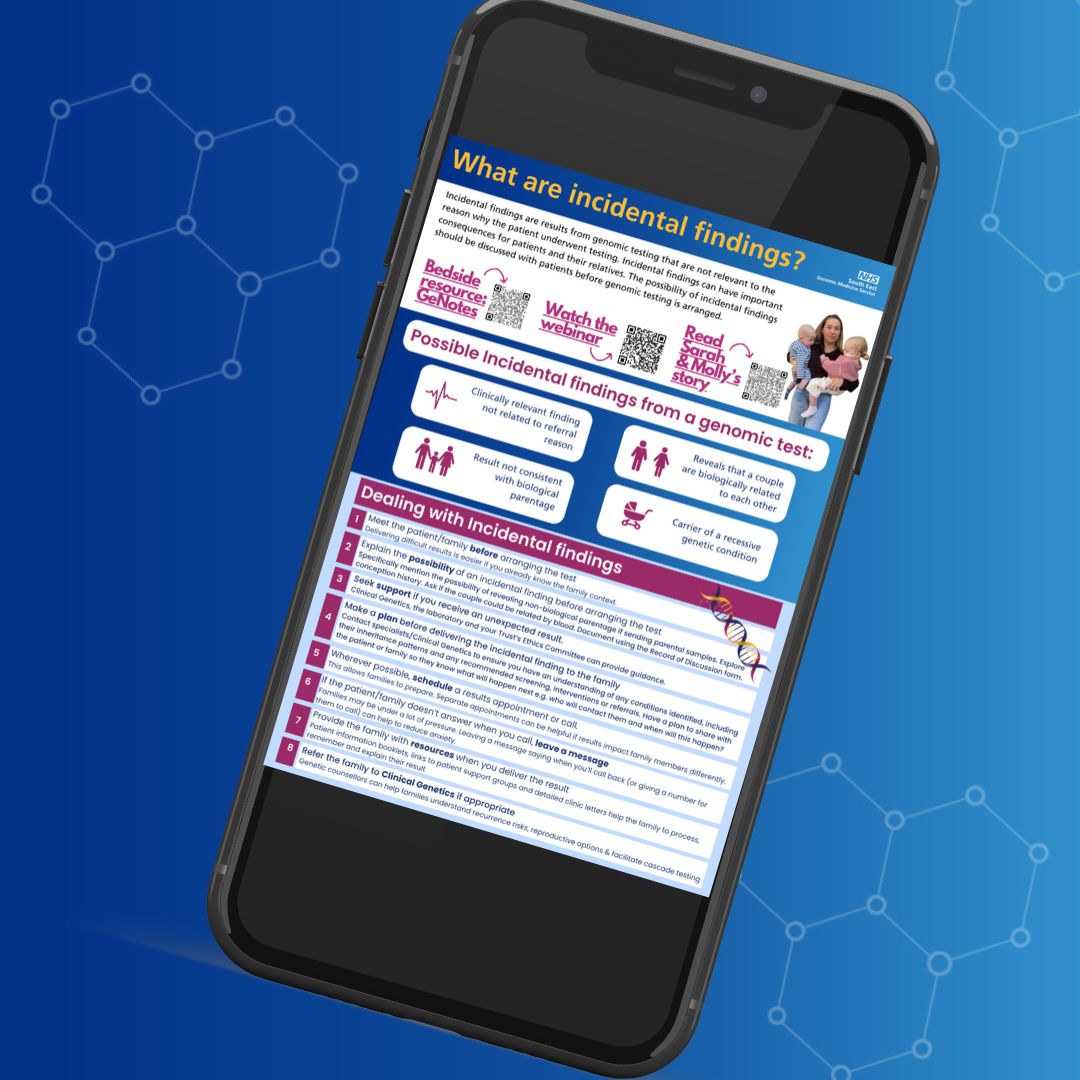
Types of Incidental Finding
A clinically relevant finding not related to the referral reason
Sometimes a genomic test detects a pathogenic variant associated with an unrelated condition .
e.g. Testing is arranged to find a cause of a child’s epilepsy and speech delay. The test identifies that the patient is a carrier of Duchenne Muscular Dystrophy.
e.g. A pregnancy is found to have an unexpected feature on a scan. Testing is arranged to look for a genetic cause. The test detects a deletion that may mean the parent has a cancer predisposition syndrome.
Clinicians should warn patients and families of the possibility of a clinically relevant incidental finding before arranging testing.
Not all incidental findings are reported. The decision to report depends on the probability an individual with the variant will develop the disease (the penetrance) and the clinical actionability e.g. whether any screening or treatment is available.
Watch our webinar to learn from cases in which a clinically relevant incidental finding was reported.
Read our helpful guide for top tips relating to incidental findings.

Patient stories: Receiving a Clinically Relevant Incidental Finding


A result not consistent with biological parentage
Sometimes genomic testing involves analysing DNA samples from the patient and their parents. In these cases, it is possible testing will reveal that a parent is not the biological parent of the child. Testing could reveal non-paternity or non-maternity.
Current Record of Discussion forms do not specifically mention the possibility of revealing non-biological parentage. However, it is important to discuss this when taking consent for the test (if relevant). This may encourage families to share any uncertainties regarding paternity.
It is also helpful to explore conception history during the consent conversation. Was the child conceived via IVF? Were donor gametes used?
If the family disclose any information that may make a finding of non-biological parentage more likely, please inform the genomics lab when you request the test.
Watch our webinar to learn from cases in which non-biological parentage was reported.
Read our top tips guide for more ideas.

A finding that a couple are biologically related to each other
An unexpectedly high number of homozygous variants could indicate that a couple are biologically related to each other. These types of finding are most commonly identified via SNP arrays.
This type of incidental finding may be a safeguarding issue, particularly if one parent was a minor at the time of conception, is vulnerable, or has a learning disability.
Multiple loops of consanguinity due to cultural reasons or geographical isolation could complicate estimates of relatedness.

Carrier of a recessive genetic condition
This type of genetic finding is not typically reported by NHS laboratories. Everyone is likely to be a carrier of several rare recessive conditions. However, recessive conditions are only inherited if both partners are carriers of the same condition. The chance of an unrelated partner being a carrier of the same rare recessive condition is low.
The British Society of Genomic Medicine Guidelines recommend not reporting carrier status because ‘such
variants are not of relevance to the clinical presentation… reporting those variants in the context of a test to
investigate the cause of the patient’s rare disorder has greater potential to mislead than to appropriately inform‘.
In some circumstances, carrier status may be reported. For example, if a single variant is detected in a gene associated with an autosomal recessive condition and the patient’s phenotype is compatible with the disorder. In this case, the finding may be reported as it is possible that the patient has a second variant in the gene that could not be detected by our current testing capabilities.

Which incidental findings are reported?
The British Society for Genetic Medicine (BSGM) have published guidelines to support decision making around incidental findings.
A guide to dealing with incidental findings
-
Meet the patient/family before arranging the test.
Delivering difficult results is easier if you have already met the family and know the family context.
-
Explain the possibility of an incidental finding before arranging the test.
Clinicians requesting genomic testing should warn the patient/family that the test could reveal unexpected information. The Record of Discussion form can be used to guide and document this discussion.
Whilst the Record Discussion form doesn’t specifically mention the possibility of a genomic test revealing non-biological parentage, it is very important to mention this possibility if the test you are requesting includes parental DNA samples. Discussing this at the start gives families the opportunities to share any uncertainties they have about paternity.
It is also helpful to explore conception history:
- Was the child conceived via IVF?
- Were any donor gametes or donor embryos used?
It is also useful to ask if the couple could be related by blood as this could be revealed by testing.
If the family discloses any information during the consent conversation, please inform the genomics laboratory. This will influence how the laboratory interprets the results. It can save a lot of time and anxiety if the scientists know from the start that there is a greater chance of revealing non-paternity or non-maternity.
-
Seek support if you receive an unexpected result.
Clinical Genetics, the laboratory and your Trust’s Ethics Committee can all provide guidance.
You can contact your local Clinical Genetics team for support by email or phone.
It may also be helpful to discuss the finding with colleagues to form a plan.
If testing reveals a clinically relevant finding that’s not related to the referral reason, it can be helpful to contact other specialist teams for advice regarding screening and management.
-
Make a plan before delivering the incidental finding to the family.
Contact relevant specialists or your local Clinical Genetics department to ensure you have an understanding of any clinically relevant findings identified, including their inheritance patterns and any recommended screening, interventions or referrals.
Have a plan to share with the patient or family when you deliver the result. It helps families to process an incidental finding if they know what will happen next e.g. who will contact them and when this will happen.
-
Wherever possible, schedule a results appointment or call.
This allows families to prepare for receiving the result and gives them the opportunity to have a partner, friend or relative with them for support.
If results impact family members differently, it may be helpful to consider arranging separate results appointments.
-
If the patient/family doesn’t answer when you call, leave a message.
Families may be under a lot of pressure and dealing with various challenges. They may miss your call. Leaving a message saying when you’ll call back (or giving a number for them to call) can help to reduce anxiety.
-
Provide the family with resources when you deliver the result.
Patient information booklets, links to patient support groups and detailed clinic letters help the family to process, remember and explain their result. It is especially helpful if families can be given clinic letter or leaflet containing a clear explanation of the finding using non-specialist terminology.
Visit our ‘Patient Resources’ webpage to find an appropriate support organisation.
-
Refer the family to Clinical Genetics if appropriate.
You are responsible for delivering results of genomic testing to the patient/family if you requested the test. However, Clinical Genetics can provide advice, guidance and further support.
If the patient/family has received a clinically relevant genetic finding, genetic counsellors can help them to understand recurrence risks and reproductive options, and facilitate cascade testing. The patient can be referred to Clinical Genetics for genetic counselling.
If testing has not identified a genomic cause of your patient’s condition and you feel a genomic cause is likely, Clinical Geneticists can provide advice and guidance around potential further testing.
Frequently Asked Questions
It is your responsibility to inform your patient of any genomic test results if you requested the test. However, Clinical Genetics can provide advice and guidance. You will need to contact Clinical Genetics directly.
You may wish to contact Clinical Genetics for advice before you deliver the result to your patient. A Clinical Geneticist may be able to help you:
- understand the clinical implications of a genomic finding
- assess whether a genomic finding explains a patient’s phenotype
- consider whether any further testing may be helpful
After delivering a result to your patient, it may be helpful to refer them to Clinical Genetics for genetic counselling. Genetic counsellors can:
- help patients/families to understand their genetic result and the implications for the wider family
- identify relatives who may benefit from genetic testing and facilitate cascade testing
- explain any reproductive options available
- support patients to make informed decisions
In some cases, a genomic report may recommend a referral to Clinical Genetics. You will need to refer the patient to Clinical Genetics. they will then triage your referral and determine the most appropriate next steps.
Genetic mosaicism would not be expected to result in a non-biological parentage finding.
If your patient receives a clinically relevant finding unrelated to the referral reason, you could contact Clinical Genetics for advice.
You may also find it helpful to visit the following websites:
GeNotes Knowledge Hub contains information about many genetic conditions, including links to clinical guidelines and patient support organisations.
GeneReviews is an international point of care resource that has produced publications outlining may different inherited conditions.
You may also find it helpful to visit the OMIM website. Search for the specific gene of interest and select the relevant page. Select ‘view clinical synopsis‘ to open a list of clinical features that have been associated with variants in the gene of interest. The clinical synopsis may help you to identify which organ systems could be affected by the variant, helping you to determine which specialist teams may wish to review the patient.
Visit our webpage for step-by-step instructions, videos and infographics to help you order the most appropriate genomic test for your patient.
Join a Community of Practice
We host several Genomic Communities of Practice (CoPs). Each group has regular online meetings packed with education and case discussions, supporting all healthcare professionals to develop their understanding of genomics and become more confident at ordering and interpreting genomic tests. The CoPs are open to doctors, nurses and other healthcare professionals across the South East region, helping to build a network of expertise and support.
Become a Nursing and Midwifery Genomic Ambassador
Are you a nurse or midwife interested in learning more about genomics? Why not join our Genomic Ambassador network?
Attend our Events
We host regular online educational sessions. Browse upcoming and past events using the buttons at the bottom of this page, or sign up to receive our newsletter to be the first to receive updates and news!
Explore the Genomics Education Programme
The Genomics Education Programme has developed a wide selection of resources to support healthcare professionals to learn more about genomics. Visit their website to choose from online courses, short videos and articles. You can even consider signing up for MSc Modules in Genomic Medicine.
The Genomics Education Programme has also developed GeNotes; Genomic Notes for clinicians. the resource is divided into two sections:
- In the Clinic resources: Focused on the point of patient care, these short scenarios look at when to consider genomic testing and what you need to do.
- Knowledge Hub: An encyclopaedia of resources, designed to support your understanding of genomics in medicine.
Explaining genomics can be challenging, especially when using an interpreter or if a patient has learning difficulties. The Genomics Education Programme has developed a range of visual communication aids that clinicians can use to help their patients understand genomic concepts. There is a wide range of aids available:
- Autosomal dominant inheritance
- Autosomal recessive inheritance
- Chromosome deletions and microdeletions
- Chromosome duplications and microduplications
- Chromosome inversions
- De novo variants
- Exclusion testing (coming soon)
- Genes, chromosomes and DNA
- Invasive prenatal genetic testing (CVS and amniocentesis)
- Mitochondrial inheritance
- Mosaicism
- Penetrance and expressivity
- Preimplantation genetic testing (PGT)
- Reciprocal chromosome translocations
- Ring chromosomes
- Robertsonian chromosome translocations
- Variants of uncertain significance (VUS)
- X-linked recessive inheritance
Visit our webpage to learn about the different organisations available to support families affected by genetic conditions. There is also support available for patients who have a suspected genetic condition but currently remain undiagnosed.
Genomic tests commissioned by the NHS are listed in the National Genomic Test Directory. Each test has specific eligibility criteria, which are also outlined in the directory.
Our ‘Order or find a test‘ page helps you to search the genomic tests available, identify their eligibility criteria and access the order forms.
‘Be Part of Research’ is a free service that makes it easy for patients to find and take part in health research across the UK. Type in the health conditions you’re interested in and the website will match you to suitable studies, and send you information on how to take part.
National Lunch & Learn Series for Nurses & Midwives:
The NHS Genomic Medicine Service also hosts a monthly online Lunch and Learn webinar for all nurses and midwives who want to gain a better understanding of the relevance of genomics for their patients. Everyone’s welcome!
Genomic Ambassadors Network for Nurses & Midwives:
Are you a nurse interested in learning more about Genomics? Join our Genomic Ambassadors Network for Nurses & Midwives.
We have a friendly network of Nurses and Midwives who help champion and spread the benefits of genomics within their Trust. We work with them, and their Chief Nurses & Directors of Midwifery, to support education and training in genomics.
We meet online on a quarterly basis. All ambassadors have access to learning, research, networking and leadership opportunities, involvement in transformation projects and writing groups for peer-reviewed publications.
We would love you to sign up to our mailing list so that we can keep you up-to-date with genomics news and events.