The biology
The genetics behind why recurrent miscarriage can happen.
This page explains the possible genetic causes of recurrent miscarriage, and the biology behind the most common one.

Why does it happen?
There are many possible reasons for recurrent miscarriage, and sometimes more than one thing plays a part. Possible causes include:
- a change in the number of chromosomes in the pregnancy, which is the most common cause of early miscarriage (this page explains more about this cause below)
- a condition that affects how the blood clots
- hormonal and endocrine issues
- differences in the shape of the womb
- cervical weakness
For many people, no cause is found. This can be very hard to hear, but most people with unexplained recurrent miscarriage still have a good chance of a healthy pregnancy in the future.
This section explains the biology that can lead to a chromosome imbalance in a pregnancy.
Genetics: the basics
Every cell in your body contains genetic material called DNA. DNA is read like a code. The code is made up of four chemical building blocks: adenine, thymine, cytosine and guanine, shortened to the letters A, T, C and G. The order of these letters tells the cell what to do. The code is slightly different from person to person, which helps make you who you are.
A gene is a section of DNA that gives the cell instructions for making a specific protein. Each protein does a particular job in your body. We each have around 20,000 genes.
Genes are arranged into structures called chromosomes. Most people have 46 chromosomes, in 23 pairs. You inherit one chromosome of each pair from each biological parent.
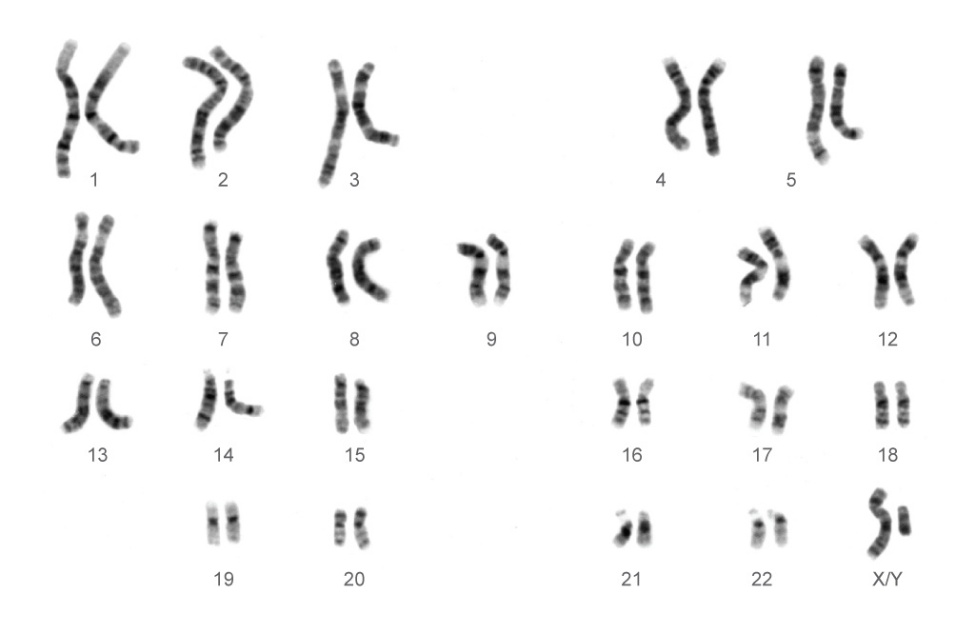
This picture below shows a karyotype, which is a complete set of chromosomes seen under a high-powered microscope. There are 23 pairs: pairs 1 to 22 (called autosomes), and the sex chromosomes (XX for female, XY for male).
Genetics as a book
To make it simpler, many people think of our genetic information as a book (Introduction to Genomics):
- a letter is a single piece of DNA
- a sentence is a gene
- a chapter is a chromosome
- the complete story is the genome
Changing a single letter is unlikely to change the story much, but removing a whole chapter will have a big effect. The same is true of the genetics behind recurrent miscarriage.
The genetics behind miscarriage
The most common genetic cause of pregnancy loss in the first trimester is a change in the number of chromosomes. This is called aneuploidy. Up to 60% of early pregnancy losses are due to aneuploidy.
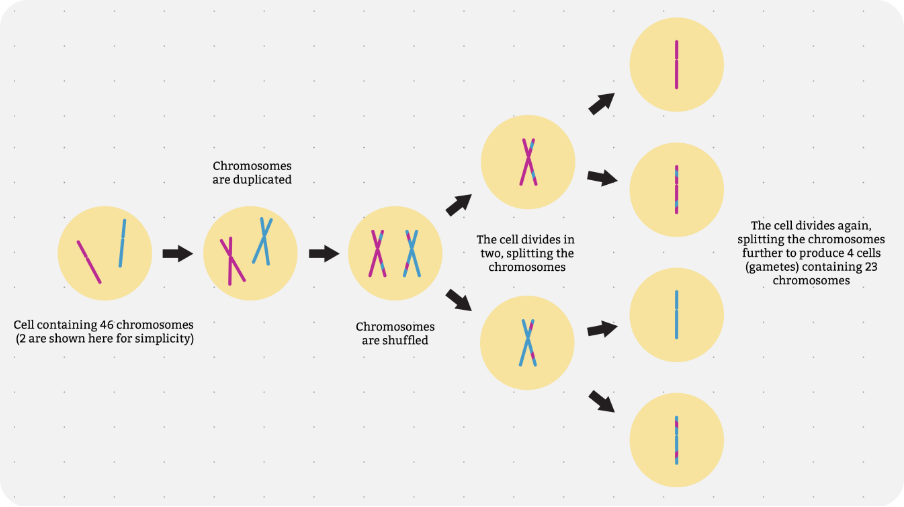
Aneuploidy usually happens by chance when an egg or sperm is being made. Eggs and sperm are made through a process called meiosis. During meiosis, the chromosome pairs line up and the cell divides, so that each egg or sperm has half the usual number of chromosomes (23). When an egg and sperm meet, the two halves join to make the expected 46 chromosomes.
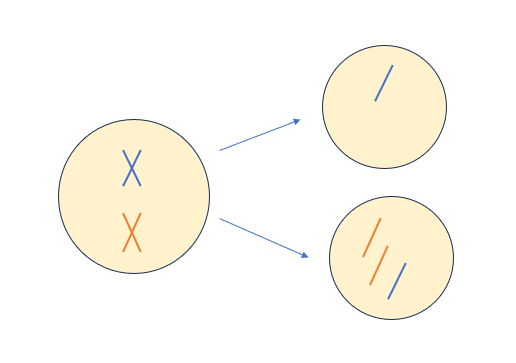
Sometimes during meiosis a chromosome pair fails to separate. This is called nondisjunction. It means the egg or sperm ends up with too many or too few chromosomes, so the pregnancy has aneuploidy. Nondisjunction cannot be predicted or prevented. It can happen at any age, but it becomes more likely as the mother gets older.
In this picture, the blue chromosome is chromosome 1 and the orange chromosome is chromosome 2. Chromosome 1 separates as expected, so each egg or sperm has one copy, which becomes two copies at fertilisation. Chromosome 2 fails to separate (nondisjunction). One egg or sperm has no copy of chromosome 2 (top), which leads to a monosomy (only one copy of chromosome 2- this pregnancy would miscarry). The other has an extra copy (bottom), which leads to a trisomy of chromosome 2 (this pregnancy would miscarry).
The best-known aneuploidies caused by nondisjunction are:
- Down syndrome (an extra copy of chromosome 21, or trisomy 21)
- Edwards syndrome (an extra copy of chromosome 18, or trisomy 18)
- Patau syndrome (an extra copy of chromosome 13, or trisomy 13)
Not every change in chromosome number leads to pregnancy loss. Most pregnancies with trisomy 21 end in miscarriage, but a significant number continue, and the baby is born with Down syndrome.
Research shows that 50 to 60% of miscarriages are due to a chromosome imbalance in the pregnancy. Most of these are caused by nondisjunction happening by chance.
Inherited chromosome imbalance
In around 2 in 100 couples who have recurrent miscarriages, there is an inherited genetic cause. In these couples, the imbalance in the pregnancy is not caused by chance nondisjunction. It comes from a structural chromosome rearrangement carried by one of the biological parents.
The most common is a balanced Robertsonian translocation in one biological parent. This is where two chromosomes are joined together. The parent is healthy because no genetic material is missing, but their eggs or sperm can carry too much or too little, which can lead to miscarriage.
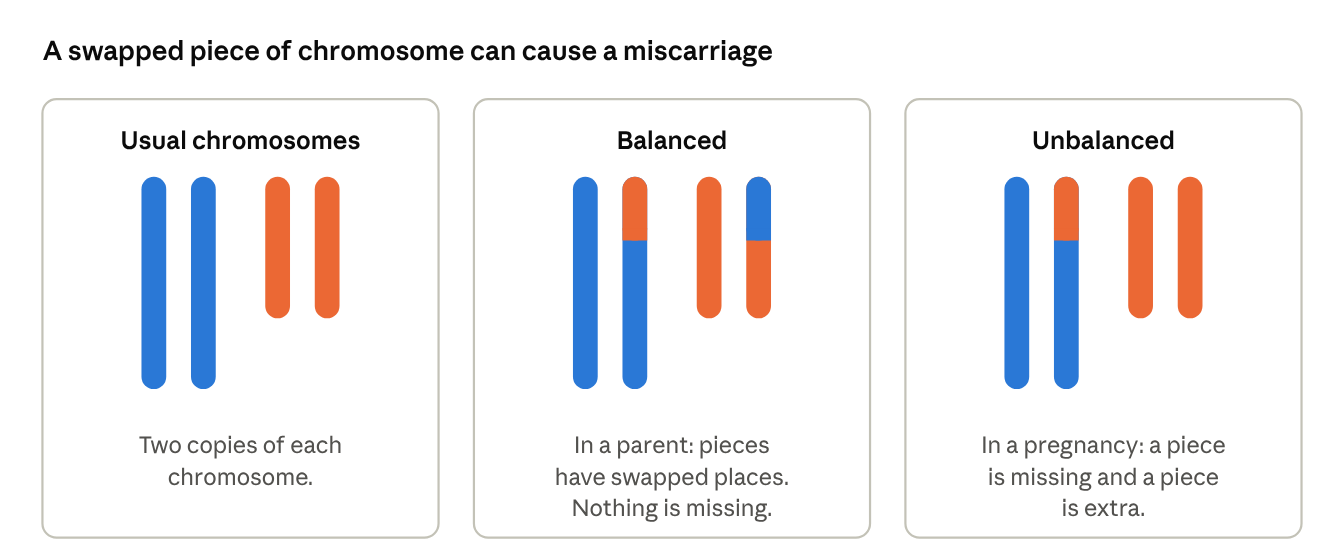
Reciprocal translocation: pieces of two chromosomes swap places.
Robertsonian translocation: two chromosomes join together.
Useful Links
Miscarriage (NHS)
The NHS guide to miscarriage: signs, treatment, causes, recovery and where to get support.
Recurrent miscarriage (Miscarriage UK)
Explains what recurrent miscarriage is, possible causes, the tests you may be offered (including genetic tests) and emotional support.
Recurrent miscarriage: definition, causes and care (Tommy's)
Plain-language overview of recurrent miscarriage, possible causes, tests and care in a future pregnancy.
Causes and risk factors for miscarriage (Tommy's)
What can and can't cause miscarriage, to help answer the question 'why did this happen?'
Causes and risk factors (Miscarriage UK)
What is known about why miscarriages happen, and what is not your fault.
Recurrent miscarriage patient information (RCOG)
The doctors' royal college explains likely causes, the tests you should be offered and treatment options.
Supporting you through miscarriage (Miscarriage UK, PDF)
A free downloadable leaflet about miscarriage and the support available.
Visual communication aid: Robertsonian chromosome translocations
An NHS picture guide that explains Robertsonian translocations and how they can affect a pregnancy.
Robertsonian translocations: pregnancy outcomes (PDF)
A printable picture guide to what can happen in a pregnancy when a parent carries a Robertsonian translocation.
Robertsonian translocations: overview (PDF)
A printable picture guide to the basics: genes, chromosomes and what a Robertsonian translocation is.
What is a chromosome? (Your Genome)
A simple explanation of chromosomes, the structures the test looks at.
What is a chromosome condition? (Your Genome)
Explains in simple terms what it means when there are too many or too few chromosomes.
Genetic, rare and undiagnosed conditions explained (Genetic Alliance UK)
Background on genetics and genetic conditions for individuals and families.