The genetic pathway
Who can have genetic testing, how it works and what your results might mean

Who can have genetic testing
If you have had three or more miscarriages, you are entitled to genetic testing of the pregnancy tissue on the NHS. Unfortunately, not everyone is offered it, so if you haven’t been offered testing, you can ask for it.
The National Genomic Test Directory
The NHS in England keeps a list of the genetic tests it pays for, and who can have each one. This list is called the National Genomic Test Directory. It means the same tests should be available to you wherever you live in England.
Tests after recurrent miscarriage
There are three tests:
| Test | Who can have it | What is tested |
|---|---|---|
| Testing the pregnancy tissue (R318) | After three or more miscarriages, where pregnancy tissue is able to be collected | Tissue from the pregnancy |
| Testing both parents (R464) | Offered in exceptional circumstances: after 5 or more miscarriages where the pregnancy tissue has not been tested, or where testing was not possible because the sample failed | A blood sample from each parent |
| Testing both parents after a pregnancy result (R465) | The test on the pregnancy tissue found a change that may have come from a parent. The exact change will decide whether testing the parents is right for you | A blood sample from each parent |
Testing the pregnancy tissue is usually the most helpful first step. This is because most chromosome changes happen by chance in the pregnancy itself, rather than being passed on from either parent.
How to ask for testing
If you are having your third miscarriage or more, tell your care team as early as you can that you would like genetic testing.
You might find it helpful to say: “This is my third miscarriage. I’d like the pregnancy tissue to be sent for genetic testing.”
Your care team can tell you how the tissue will be collected. You can read more below, under Testing the pregnancy tissue.
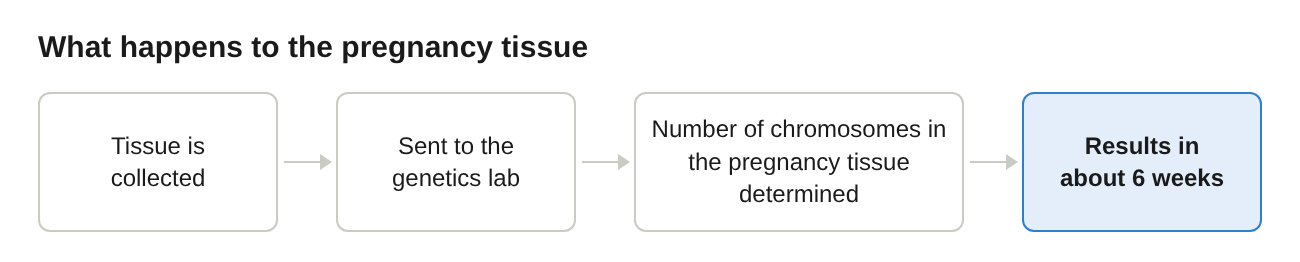
Collecting the tissue. How a miscarriage is managed depends on the type of miscarriage, how far along the pregnancy is, and your own choice. The three main options are waiting for the miscarriage to happen naturally (expectant management), taking medicine (medical management) or having a small operation (surgical management). The lab needs a sample of tissue from the pregnancy to carry out genetic testing.
Your care team can give you more information and support.
What the lab does. The tissue is sent to a specialist genetics laboratory, where it is treated with care and respect. The lab takes DNA from the tissue and then carries out two tests:
- a quick test that looks for the most common chromosome changes
- a test called a microarray, which counts the chromosomes and looks for pieces of chromosome that are missing or extra
What the tests can’t find. These tests can’t detect:
- chromosome changes where nothing is missing or extra
- very small changes in single genes
- causes of miscarriage that aren’t genetic, such as hormone problems or the shape of the womb
Why some tests don’t give a result. Sometimes there isn’t enough DNA from the pregnancy. At other times the sample is mostly made up of the mother’s tissue. In these cases, the lab may not be able to give a result.
The sex of the pregnancy. The test can show whether the pregnancy was a boy or a girl. Please tell your care team if you don’t want to know the sex. Sometimes the result itself involves the X or Y chromosome, and then your care team will need to explain it to you.
How long it takes. The lab aims to send results within 6 weeks, although it can sometimes take longer. A delay doesn’t mean there is a problem, but do contact your care team if you are worried.
Your results
There are a number of possible results, and what your result shows will decide which further tests, if any, you are offered. The table below shows some of the common results, but it doesn’t cover every possible result. Your care team will explain your own result to you.
| Result | What it means | What usually happens |
|---|---|---|
| An extra copy of a chromosome (trisomy), or a missing chromosome (monosomy) | This usually happens by chance | Depending on the chromosome involved, you and your partner may be offered a genetic blood test |
| An extra copy of chromosome 13, 18 or 21 | This usually happens by chance | You and your partner are usually offered a genetic blood test. In a future pregnancy, you will also be offered a screening test called NIPT |
| Three full sets of chromosomes (triploidy) | This happens by chance | A blood test isn't needed, as this can't be inherited |
| A piece of a chromosome missing or extra | This may have come from a parent who carries a chromosome change | Depending on the change, you and your partner may be offered a genetic blood test |
| No chromosome change found | The test didn't find a genetic cause, but other causes are still possible | We could not find a genetic reason for your miscarriage |
| No result | The lab couldn't get a result from the tissue | You and your partner may be offered a blood test |
Genetic Counselling
Genetic counselling is an appointment with a genetics specialist. They will explain your result and what it might mean for you and your family. They won’t tell you what to do, but they will help you make the choice that is right for you.
When is it offered?
You will usually be offered genetic counselling if:
- you or your partner carry a chromosome change
What happens at the appointment. You can bring your partner or someone else to support you, and it can help to write down your questions beforehand.
How to be referred. Speak to your care team for more information.
When a parent carries a chromosome change
Some people have chromosomes where pieces have swapped places or joined together, but no genetic material is missing or extra. This is called a balanced rearrangement. People with a balanced rearrangement are usually healthy, and most don’t know they have one.
However, their eggs or sperm may pass on too much or too little chromosome material. This is called an unbalanced rearrangement, and it can cause a miscarriage. Because it can happen again in future pregnancies, parents are sometimes offered testing.
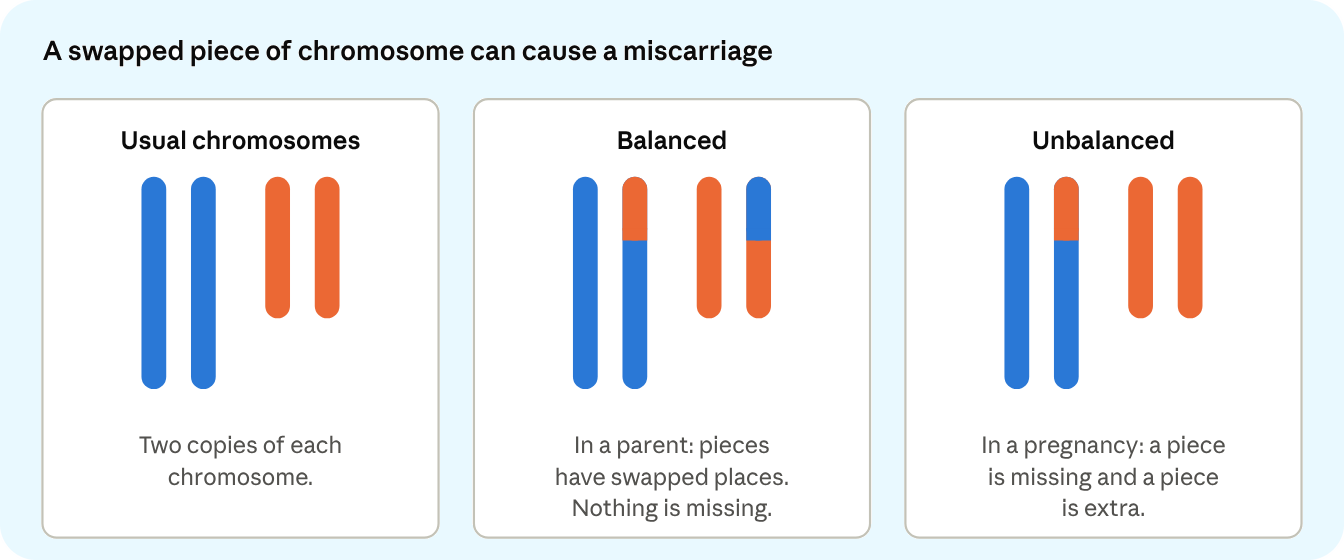
There are two main types:
- Reciprocal translocation: pieces of two chromosomes swap places.
- Robertsonian translocation: two chromosomes join together.
If you or your partner carry a chromosome change
Finding out that you carry a chromosome change can be a lot to take in. Many people who carry one go on to have a healthy baby. You will be offered genetic counselling, which gives you the chance to talk through what it means for you. Your options may include:
- trying again naturally
- tests during a future pregnancy
- IVF with testing of the embryos, known as PGT-SR
Other members of your family may also want to be tested. Your genetic counsellor can help you think about how to talk to them.
Useful Links
Testing and your results:
National Genomic Test Directory (NHS England; written for health professionals)
The official list of NHS genetic tests and who is eligible. Testing of pregnancy tissue after recurrent miscarriage is test R318. Written for professionals, but useful if you want to check what you're entitled to.
Your care after 3 miscarriages (Tommy's)
Explains what happens if a chromosome change is found, when both parents may be offered testing, and referral to genetic counselling.
Tests and treatments after miscarriage (Tommy's)
An overview of the tests and treatments offered after one, two or three miscarriages.
Genetic and genomic testing (NHS)
What genetic testing is, what results can show, and what genetic counselling involves.
NHS genetic services in the UK (Genetic Alliance UK)
How NHS genetic services work and how people are referred.
Patients and public (South East Genomics)
Information from the NHS genomics service for South London, Kent, Medway, Sussex and much of Surrey, including what genomics means for you and your family.
Your questions answered (South East Genomics)
Common questions about NHS genomic testing.
Our leaflet: Genetic testing for Recurrent Miscarriage
Our leaflet about genetic testing of the pregnancy tissue.
What happens to my baby's body after a miscarriage (Tommy's)
Your choices about the pregnancy remains, including testing, and what hospitals do with them.
Your options and decisions during miscarriage (Tommy's)
Explains waiting, medicine and surgery as ways to manage a miscarriage. Useful to know when planning how a sample can be collected for testing.
What is genetic testing? (Your Genome)
An easy introduction to how genetic tests work.
Balanced translocations (Unique, PDF)
A guide for anyone told they or their partner carry a balanced translocation, including a section on miscarriage and pregnancy loss, and options for future pregnancies.
Unique guides to chromosome changes (Unique)
Free, plain-language guides to specific chromosome changes.
Genetic counselling and your baby's genes (Tommy's)
What genetic counselling is and when it may help before another pregnancy.
Non-invasive prenatal testing (NIPT) (ARC)
If your result showed an extra copy of chromosome 21, 18 or 13, you can be offered NIPT in a future pregnancy. This explains the test.
Screening for Down's, Edwards' and Patau's syndromes (NHS)
How screening works in pregnancy, including NIPT.
Unique helpline (Unique)
Help understanding a chromosome result and connecting with other families.
ARC helpline (ARC)
Non-directive support from trained staff about tests and results in pregnancy, and decisions after a result.
Getting the right care
Recurrent miscarriage clinics (Tommy's), if no cause is found
Specialist NHS clinics in Birmingham, Coventry and London for people with 3 or more miscarriages or a late miscarriage. You don't need to live nearby.
Find an Early Pregnancy Unit (Association of Early Pregnancy Units)
A map of over 200 NHS Early Pregnancy Units across the UK.
Recurrent miscarriage (Green-top Guideline No. 17) (RCOG; written for health professionals)
The guideline doctors follow for investigating recurrent miscarriage, including genetic testing. Written for professionals.
Miscarriage bereavement care pathway (National Bereavement Care Pathway)
The standards of bereavement care hospitals in England aim to give after a miscarriage.
Pregnancy Loss Review (Department of Health and Social Care)
The 2023 independent review of care for pregnancy loss before 24 weeks, with 73 recommendations.
NHS 111
For bleeding, pain or other physical concerns, contact your Early Pregnancy Unit, GP or NHS 111. In an emergency call 999.
Another pregnancy
Pregnancy after a miscarriage (Miscarriage UK)
Coping with anxiety in a new pregnancy, extra scans, progesterone and peer support groups.
Pregnancy after miscarriage (Tommy's)
What to expect and what extra care you may be offered.
Thinking about another pregnancy (Miscarriage UK)
Help with deciding if and when to try again.
Miscarriage Support Tool (Tommy's)
An online tool estimating your chance of a successful next pregnancy, with personalised guidance.
Taking progesterone in early pregnancy (Tommy's)
Who may be offered progesterone after miscarriage and how it is taken.
Another pregnancy (ARC)
Support for pregnancy after a difficult result or loss, including screening options.
Pregnancy after loss support groups (Miscarriage UK, Facebook)
Private peer groups for those pregnant again after loss (one for 0 to 13 weeks, one from 14 weeks).
Thinking about stopping trying (Miscarriage UK)
Support if you're considering not trying again.