What genetic tests are available
Who can have testing, how the tests work, and what the results mean
Genetic testing of the pregnancy tissue is available on the NHS from the third miscarriage. This page sets out who is eligible, how the tissue is tested, and what to do after each result.

Who can have genetic testing
All NHS genetic testing in England is listed in the National Genomic Test Directory, so the same tests should be available wherever your patient lives. Always check the current criteria before requesting. There are three tests after recurrent miscarriage.
| Test | Who is eligible | What is tested |
|---|---|---|
| R318 Recurrent miscarriage | The third miscarriage, and each one after that, where pregnancy tissue is available | The pregnancy tissue. R318.1 is a genome-wide common aneuploidy test. If no aneuploidy is found, R318.2 genome-wide microarray follows. This is the gold standard test. |
| R464 Parental karyotype (no tissue result) | In exceptional circumstances: 5 or more losses where no pregnancy tissue was tested, or 3 or more where the samples were unsuitable or failed | A blood sample from both parents. Of limited value after a failed sample, so testing the next pregnancy loss is usually more informative. |
| R465 Parental testing after an abnormal result | An unbalanced abnormality found in the pregnancy tissue | A blood sample from both parents (karyotype or targeted chromosome analysis), to look for a balanced rearrangement. |
The losses don’t need to be consecutive or with the same partner, and very early losses (biochemical pregnancies) count. Ectopic and molar pregnancies don’t count. R318 can’t be requested for a first or second miscarriage. For fewer than three losses, R22 may apply where a pregnancy loss has features suggesting a chromosome abnormality.
Testing the pregnancy tissue is usually the most helpful first step. This is because most chromosome changes happen by chance in the pregnancy itself, rather than being passed on from either parent.
The clinical pathway
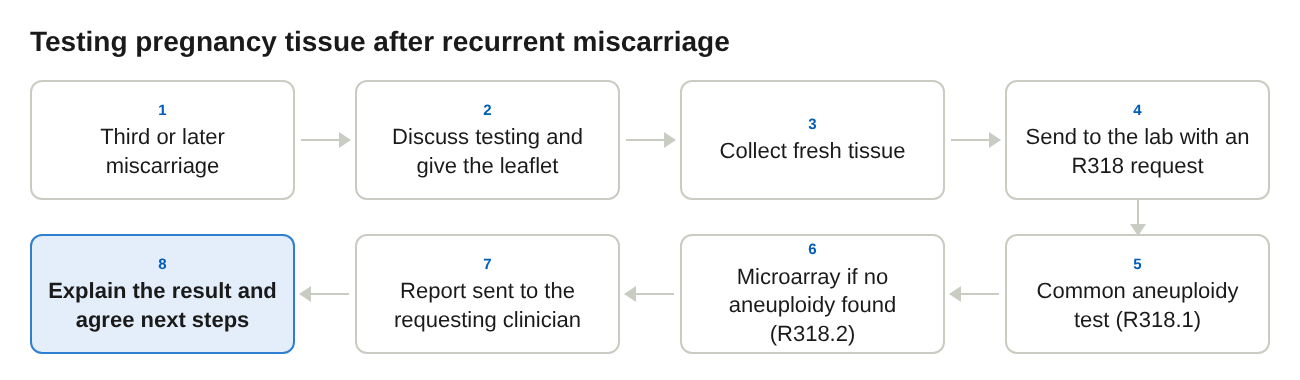
People with a suspected miscarriage may present to their GP, A&E or their Early Pregnancy Unit. Those seen by a GP or A&E are referred to the EPU. After three or more miscarriages, they should be referred to a recurrent miscarriage clinic to discuss possible causes, including genetics. Waits for that clinic vary from 2 to 12 months, so the EPU is often the best place to arrange testing of the pregnancy tissue.
The tests explained
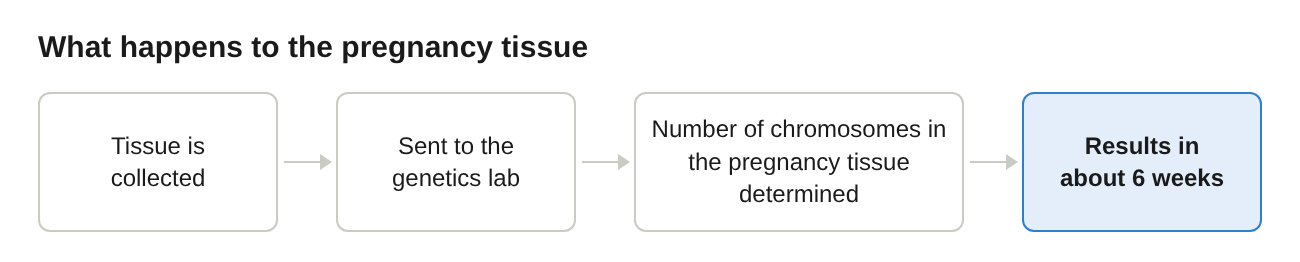
The tissue is sent to the South East Genomic Laboratory Hub, where it is treated with care and respect. The lab extracts DNA and first runs R318.1, a quick common aneuploidy test (QF-PCR). If no aneuploidy is found, R318.2 genome-wide microarray follows. This counts the chromosomes and looks for pieces of chromosome that are missing or extra.
- Balanced rearrangements, where nothing is missing or extra.
- Very small changes, such as single-gene changes.
- Causes of miscarriage that aren’t genetic, such as clotting conditions, hormonal problems or the shape of the womb.
In the South East, 16% of samples couldn’t be tested. Common reasons are that the referral didn’t meet the criteria (for example, a first or second loss), there wasn’t enough pregnancy tissue or DNA, or the sample was mostly the mother’s tissue (maternal cell contamination).
The test can show the sex of the pregnancy. Ask whether the patient wants to know. If the result involves the X or Y chromosome, it will need to be discussed.
The lab’s average turnaround for fetal loss microarray is 5 to 6 weeks, against a national target of 90% within 42 days. Results go to the clinician who requested the test.
How to request testing
Before you request R318, check that this is your patient’s third miscarriage or later, and talk to them about the test, including whether they want to know the sex of the pregnancy. Give them our patient leaflet. For help choosing and ordering the right test, including request forms and step-by-step guidance, see our Support with arranging genomic testing page.
Results and next steps
Results are sent to the clinician who requested the test. Explain the result to the patient, or refer them to someone who can. The table shows the common results. It doesn’t cover every possible result.
| Result | What it usually means | Next steps |
|---|---|---|
| Trisomy or monosomy | Usually happens by chance | Depending on the chromosome involved, both parents may be offered a genetic blood test |
| Trisomy 13, 18 or 21 | Usually happens by chance | Both parents are usually offered a genetic blood test. NIPT can be offered from 10 weeks in a future pregnancy (R445) |
| Triploidy | Happens by chance | No parental testing, as it can't be inherited |
| Sex chromosome aneuploidy | Happens by chance | No parental testing needed |
| Unbalanced structural abnormality | May come from a parent with a balanced rearrangement | Offer both parents testing (R465) and refer to Clinical Genetics |
| No abnormality found | No chromosomal cause found. Other causes are still possible | No further genetic testing. Continue recurrent miscarriage investigations |
| Failed or unsuitable sample | No result | Test the next loss if possible. Parental karyotype (R464) may be considered |
When a parent carries a balanced rearrangement
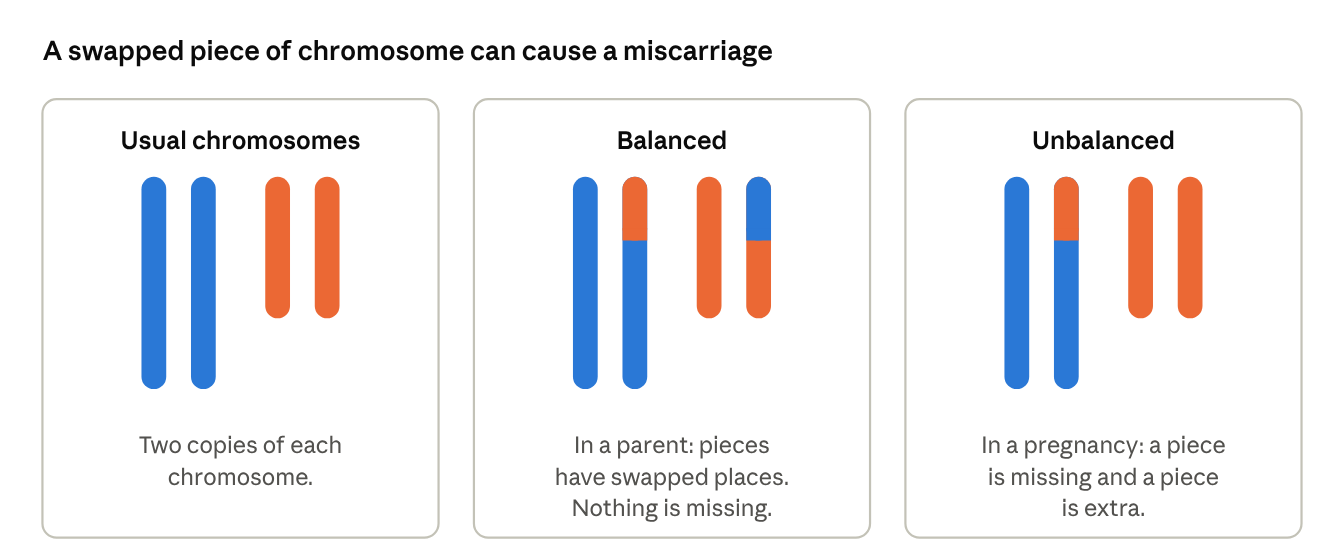
In a balanced rearrangement, pieces of chromosome have swapped places or joined together, but nothing is missing or extra. Carriers are usually healthy and most don’t know. Their eggs or sperm may pass on an unbalanced rearrangement, which can cause miscarriage and can happen again.
Reciprocal translocation: pieces of two chromosomes swap places.
Robertsonian translocation: two chromosomes join together.
Carriers should be referred to Clinical Genetics for genetic counselling. Many carriers go on to have a healthy baby. Options include trying again naturally, testing in a future pregnancy, and IVF with embryo testing (PGT-SR). Other family members may also want to be tested.
Genetic counselling and referral
A Clinical Genetics referral isn’t needed for most results. Refer to Clinical Genetics if:
- the pregnancy tissue shows an unbalanced structural abnormality
- either parent is found to carry a balanced rearrangement
- there is a relevant family history
Genetic counselling helps patients understand the result and what it means for them and their family, without telling them what to do.
Useful links
NIPT after a previous trisomy, R445 (PDF)
Information for healthcare professionals on NIPT in a future pregnancy.
Balanced translocations (Unique, PDF)
A guide for carriers, including miscarriage and options for future pregnancies.
Find an Early Pregnancy Unit (AEPU)
A map of over 200 NHS Early Pregnancy Units across the UK.